FPI selling is not stopping, Indian shares worth ₹22530 crores sold so far in January; What are the reasons – FPI withdrew over Rs 22530 crore from Indian equities so far in January here are the reasons

Foreign portfolio investors (FPIs) have pulled out more than Rs 22,530 crore from Indian stocks so far in the month of January. The main reasons for this are the increase in US bond yields and the strengthening of the dollar. In the year 2025, FPI had sold Rs 1.66 lakh crore in the Indian equity market. This was due to currency volatility, global trade tensions and fears of US tariff increases, and high market valuations. The value of the rupee declined by about 5 percent against the dollar during 2025. Continuous selling by FPI played an important role in this.

According to NSDL data, FPIs pulled out Rs 22,530 crore from Indian equities between January 1 and 16. Market experts have attributed this withdrawal to global and domestic factors. According to news agency PTI, Sachin Jasuja, equity head and founding partner of Centricity Wealthtech, said that rising yields on US bonds and a strong dollar have improved risk adjusted returns in developed markets. In such a situation, capital is leaving emerging markets and going towards other markets.

Himanshu Srivastava, principal manager-research, Morningstar Investment Research India, said increased yields on US bonds and the strength of the dollar have made US assets comparatively more attractive. Geopolitical and trade uncertainties continue to weigh on investors’ risk appetite towards emerging markets.

These factors are also the reason

VK Vijayakumar, Chief Investment Strategist, Geojit Investments, says that the uncertainty regarding the US-India trade agreement has also weakened the sentiment of investors. On the domestic front, extremely high valuations in some market segments, coupled with mixed signals from the ongoing earnings season, have led to foreign investors booking profits. Also the portfolio has been rebalanced. Vijayakumar said that unless a clear positive trigger is found for the market rally, this selling trend may continue.

Source link

ICICI Prudential AMC is distributing interim dividend of ₹ 14.85, record date is on this day in the new starting week – icici prudential amc is giving rs 14 85 per share interim dividend for fy26 record date is on january 21 should you buy

ICICI Prudential Asset Management Company Ltd is going to pay an interim dividend of Rs 14.85 per share for the financial year 2026. The record date for this is 21 January 2026 in the new week.

Shareholders whose names appear in the Register of Members of the Company or the records of the depositories as beneficial owners of shares as on this date will be entitled to receive the dividend.

ICICI Prudential AMC had announced this dividend on January 14, when the company’s October-December 2025 quarter results were released. The company was listed on BSE, NSE on 19 December 2025.

Its IPO of Rs 10602.65 crore was filled 39.17 times. The promoters held 87.59 percent stake in the company as of December 18, 2025. The face value of the share is Rs 1.

ICICI Prudential AMC’s December 2025 quarter net profit increased 45 percent year-on-year to Rs 917 crore. A year ago the profit was Rs 632 crore.

Revenue from operations increased by 23.5 percent to Rs 1514.67 crore. Revenue in the December 2024 quarter was Rs 1226.66 crore.

The share price of ICICI Prudential AMC is currently Rs 2933.55 on BSE. The market cap of the company is more than Rs 1.45 lakh crore.

The stock has risen 10 percent in a week. It has so far seen a record high of Rs 2971.95 and a record low of Rs 2528.90 on BSE since its listing.

Recently the one month shareholder lock-in of ICICI Prudential AMC ended. After this, 70 lakh shares became free for trading, which is equivalent to 1 percent stake.

ICICI Prudential AMC’s revenue increased by 32 percent during FY 2025. Meanwhile, net profit increased by 29 percent.

Story continues below Advertisement

Source link

Brokerage bullish on these 10 stocks – stocks to buy brokerage bullish on infosys itc hotels hdb financial indian hotels hdfc amc icici lombard tbo tek max healthcare just dial emmvee power watch video to know more

markets

Stocks to Buy: Brokerage houses have given bullish opinion on 10 stocks after the December quarter results. These stocks of banking, finance, hospitality, healthcare and solar sectors are showing return potential of 13% to 70%. Check the complete list.

Source link

Copper ETF: Copper became an ‘asset’ from metal, know how you can invest in copper ETF – copper etf investing guide how copper became a strategic asset in ev ai renewable energy and power infrastructure

Copper ETF: The identity of copper is changing rapidly in markets around the world. It was previously considered a cyclical metal associated with the construction and manufacturing cycle. But, now it has come at the center of two biggest changes of the 21st century like digitalization and energy transition.

The need for copper in electric vehicles, renewable energy, data centers and power grids is increasing rapidly. This is the reason why copper prices have crossed $13,000 per tonne several times. Analysts believe that there may be a structural reduction in the supply of copper in the global market by 2026. Now the discussion has moved from fear of oversupply to long-term shortage.

Why is investor interest increasing in copper?

The changing role of copper has increasingly attracted the attention of investors. Wealth Enrich founder and wealth expert Advait Arora wrote on X (earlier Twitter) that copper should now be viewed like traditional strategic assets.

According to him, if an investor is interested in copper, he should think of it in terms of EVs, renewable energy, infrastructure and ‘new age gold’. This statement makes it clear that copper is going to become an important part of future industries in the coming times.

What are the options for investing in copper?

For investors who want to participate in this copper theme, Advait Arora has suggested three major exchange traded funds (ETFs). These ETFs provide exposure to copper in different ways. However, it is worth noting that there is no ETF for copper in India as of now. But, investments can be made in these from India also.

Global COPX is considered to be the largest and most established ETF in this category. It has net assets of about $5.83 billion and its expense ratio is 0.65 percent. This ETF invests in about 40 copper mining companies around the world.

United States Copper Index Fund (CPER): For investors who want exposure to copper prices directly rather than to mining companies, CPER is a unique option. This ETF tracks copper futures, meaning its performance is directly linked to commodity price movements. The net assets of this fund are approximately $456 million. In the last one year it has given returns of about 38 percent.

iShares Copper and Metals Mining ETF (ICOP): ICOP takes a slightly broader approach. It is not limited to just copper, but tracks the STOXX Global Copper and Metals Mining Index. Launched in 2023, this ETF has gained good popularity in a short time. In the year 2025, this ETF gave a return of about 78 percent.

How should Indian investors invest in these ETFs?

Indian investors can invest in these global ETFs through overseas investment platforms under the Liberalized Remittance Scheme (LRS). However, it is important to pay attention to some important things before investing.

This includes currency risk, expense ratio of ETF and fixed limit of LRS. It is also important to understand that most such ETFs provide exposure to copper by investing in mining companies rather than directly in spot copper.

Copper: Big opportunity, but with risks

The copper story looks strong in the long term, but it is still a cyclical commodity. It is not a safe haven like gold. During economic slowdown its demand can weaken rapidly. Apart from this, geopolitical events and changes in policies of major copper producing countries also have a direct impact on prices.

On the other hand, supply side challenges remain. New mines often take 10 years or more to start up. This combination of rising structural demand and slow supply makes copper an attractive but volatile investment option.

Why are investors stopping SIP, what are they afraid of; What harm will this cause? understand the whole matter

Disclaimer: The advice or opinions expressed on Moneycontrol.com are the personal views of the expert/brokerage firm. The website or management is not responsible for this. Moneycontrol advises users to always seek the advice of a certified expert before taking any investment decision.

Source link

Stocks to Buy: Brokerage is bullish on these 10 stocks, you can get returns up to 70%; Would you bet? – stocks to buy brokerage bullish on infosys itc hotels hdb financial indian hotels hdfc amc icici lombard tbo tek max healthcare just dial emmvee power

Stocks to Buy: The season of December quarter (Q3) results has started. Brokerage houses have updated their views on many big stocks. Based on reports from top research firms like Motilal Oswal, Nomura, Nuvama, UBS and Jefferies, we have shortlisted 10 stocks from banking, finance, auto and consumer sectors, which can give returns of up to 70%.

Nomura has maintained ‘Buy’ rating on Infosys and given a target of ₹1,810, which shows about 13% upside. According to the brokerage, the company’s guidance upgrade has improved growth visibility despite macro uncertainty.

Infosys has received big deal orders worth $4.85 billion. Also, six big opportunities related to AI – such as AI engineering, data platform and software modernization can support medium term growth.

Nomura has initiated coverage on ITC Hotels with a ‘Buy’ rating and a target of ₹230. This suggests returns of around 20% over the next 12 months.

The brokerage believes that high-single digit RevPAR growth, strong ARR and better occupancy in newly opened hotels will support the company’s growth.

Jefferies maintains a ‘Buy’ rating on HDB Financial Services with a target of ₹920, which implies an upside of about 20%.

The company’s profit increased by 36% to ₹640 crore in Q3. Provisions remained low and fee income was high. AUM grew 12% to ₹11.49 lakh crore, while NIM stood at 8.1%.

Nomura has ‘Buy’ rating on Indian Hotels (IHCL) and a target of ₹830, which suggests an upside of about 22.4%.

According to the brokerage, ADR growth may remain strong as hotel room supply is limited in key business cities. New supply is expected to be very limited between FY25-30.

Motilal Oswal has ‘Buy’ rating on HDFC Asset Management Company and a target of ₹3,200. This shows an increase of about 25% from the current level.

The brokerage expects 16% CAGR in revenue, EBITDA and PAT and 18% CAGR in AUM during FY25-FY28. Despite rising employee expenses, the company’s EBITDA margin remains strong at 81.5%.

Jefferies has maintained ‘Buy’ rating on ICICI Lombard General Insurance and given a target of ₹2,400, which is about 27% upside.

Q3 results were around estimates after removing labor code-related one-time expenses. However, profitability remained under pressure due to high loss ratio in motor insurance.

Anand Rathi has maintained his BUY call on TBO Tek and increased the target price to ₹2,000 from ₹1,725 ​​earlier. This indicates a return of about 32% from the current level.

The brokerage says that TBO Tek’s hold in global travel distribution has further strengthened after the acquisition of Classic Vacations (integration in October 2025). Rapid growth in the hotel segment, expansion in international markets, signs of stability in India business and increasing share of new travel agents are important growth drivers for the company.

UBS believes that growth visibility at Max Healthcare has improved following recent capacity additions. The brokerage has given a target of ₹1,475, which shows about 45% upside.

New hospital beds and better occupancy are expected to strengthen earnings in the coming time.

Nuvama has maintained ‘Buy’ rating on Just Dial and given a target of ₹1,100. This indicates an increase of about 52% compared to the current price of ₹722.

Revenue growth may be limited, but profitability has improved in the short term. EBITDA margin stood at 31.2%, which was better than expected.

Emmvee Photovoltaic Power

Jefferies has maintained ‘Buy’ rating on Emmvee Photovoltaic Power and given a target of ₹320. This shows a return potential of over 70% over the next 12 months.

The brokerage believes solar installations in India will grow at 24% CAGR during FY25-FY28. Early entry into TOPCon technology, strong DCR profitability and a strong balance sheet give the company an edge.

Dividend Socks: Lots of dividends, stock splits, bonus issues next week; Corporate action will be seen in these 10 companies

Disclaimer: The advice or opinions expressed on Moneycontrol.com are the personal views of the expert/brokerage firm. The website or management is not responsible for this. Moneycontrol advises users to always seek the advice of a certified expert before taking any investment decision.

Source link

Why are investors stopping SIP, what are they afraid of; What harm will this cause? Understand the whole matter – why investors are stopping sips rising sip stoppage ratio fear of market volatility and long term wealth loss explained

Systematic Investment Plan i.e. SIP was started so that the interference of emotions in investment is reduced and people can create wealth in the long run with discipline. But the reality is that emotions still remain the biggest enemy of SIP investors.

As soon as there is a correction in the market or there is a prolonged slowdown, a large number of investors stop SIP midway. Data for December 2025 shows that investment in mutual funds through SIP declined by more than 6 percent.

Let us know the reasons why investors are stopping SIP and what harm it can cause.

Why is SIP Stoppage Ratio an alarm bell?

Data from the Association of Mutual Funds of India (AMFI) shows that the trend of closing SIPs has increased continuously in the last five years.

  • FY22: 41.74%
  • FY23: 56.94%
  • FY24: 52.41%
  • FY25: 75.63%
  • FY26 (till December): 98.98%

The situation in FY26 became such that as many new SIPs were started, almost the same number of SIPs were closed. This figure is much higher than the normal historical level of 40-50% and clearly shows the uneasiness of investors.

SIP discontinuance: Investment in mutual funds is decreasing, know due to which 5 reasons investors are closing SIP

The weak link hidden behind increasing SIP amount

On the face of it, it seems that the SIP culture is getting stronger in India. Every year a new record of investment in SIP is being created.

But beneath this lies a less discussed truth. Money is coming in in SIP, but a large number of SIPs are not running long enough for the investor to get the real benefit from them. Registration of new SIPs has slowed down, while the number of SIPs being closed has increased rapidly.

Why do investors leave SIP midway?

Market fall: The biggest benefit of SIP is available during market decline. When the market falls, the same monthly investment buys more units and the average cost comes down. This is rupee cost averaging.

But this period is also the most frightening for investors. As soon as the decline is seen, panic increases and the SIP is stopped. Often investors think that they will start SIP again when the situation improves, but by then the market has gone up.

Financial compulsion: Fear is not the reason for stopping SIP every time. Circumstances like job loss, medical emergency, increasing household expenses or loss in business force many investors.

The Corona period was a big example of this, when the SIP stoppage ratio increased as uncertainty increased.

Why SIP is the easiest and smartest way to invest in mutual funds, know the answer in 8 points - why SIP is the smartest way to invest in mutual funds explained in

Incomplete understanding: Many new investors consider SIP as a means of short term earning. In a bull market, expectations become very high and as soon as returns weaken, SIPs are closed.

Some investors stop SIP just because their fund has not performed well in a year. This thinking is completely contrary to the basic spirit of SIP.

Quick Exit: AMFI data shows that investors stay longer in Regular Plan (investment with advice). At the same time, direct plans i.e. investments of their own choice are closed quickly.

The share of direct plans in SIP lasting more than 5 years is only 19%. Whereas in the regular plan it is 33%. This means that investors in direct plans are more afraid of market decline and close SIPs early. The presence of an advisor protects investors from emotional decisions.

SIP closure easy: Today, as easy as it is to start a SIP, it has become even easier to stop it. After one or two bad months, SIP is stopped without much thought.

This facility provides relief in the short term, but causes huge losses in the long term.

How much loss is caused by stopping SIP midway?

The key to building wealth through SIP is compounding. If you stop SIP midway, the biggest loss is due to compounding. Now suppose an investor does a SIP of ₹5,000 per month and gets an average return of 12%.

  • In 5 years: ~₹4 lakh
  • In 10 years: ~₹11 lakh
  • In 15 years: ~₹23 lakh
  • In 20 years: ~₹46 lakh

If an investor stops SIP at 10 years, he loses about 76% of his wealth compared to 20 years. The real magic of compounding happens in the second decade, but most investors exit before they get there.

Why SIP is the easiest and smartest way to invest in mutual funds, know the answer in 8 points - why SIP is the smartest way to invest in mutual funds explained in

Missing the best days of the market

Equity returns are generated on select days. If the investor stops SIP, then the most important days of sharp market recovery are missed.

Sensex data shows that missing the 10 best days can reduce returns by more than half. Missing the 30 best days can wipe out all returns. This clearly means that SIP does not fail because the market does not give returns. SIP fails because the investor abandons it midway.

The most money is made when it seems most difficult to continue investing. Investors who stop SIP for temporary relief suffer permanent losses in the long run.

Retirement fund of ₹1 crore through SIP! How much time will it take, how much SIP will have to be done; understand the calculation

Disclaimer: The information provided here is being given for information only. It is important to mention here that investing in the market is subject to market risks. As an investor, always consult an expert before investing money. Moneycontrol never advises anyone to invest money here.

Source link

Market Next Week: Smallcap stocks gain 62%, know how the market may move next week – market next week smallcap stocks gain 62 percent find out how the market may move next week

Market Next Week: The major indexes lagged the benchmarks for the week ending January 16. Mid-cap and small-cap indices continued to decline for the second consecutive week. In the week ending January 16, BSE Sensex fell by 5.89 points and closed at the level of 83570.35. Whereas Nifty50 index closed at the level of 25694.35 with a gain of 11.05 points or 0.04 percent.

On the sectoral front, Nifty consumer durable, realty, pharma and healthcare sectors declined by 2 percent. Nifty Auto Index saw a decline of 1.75 percent. Nifty Media index fell 1 percent. On the other hand, Nifty PSU Bank and Metal index saw a rise of 4.5 percent and Nifty IT index saw a rise of 2.8 percent.

Foreign institutional investors (FIIs) continued their selling this week as they sold equities worth Rs 14,265.58 crore. In contrast, Domestic Institutional Investors (DIIs) supported the market by buying equities worth Rs 16,173.69 crore.

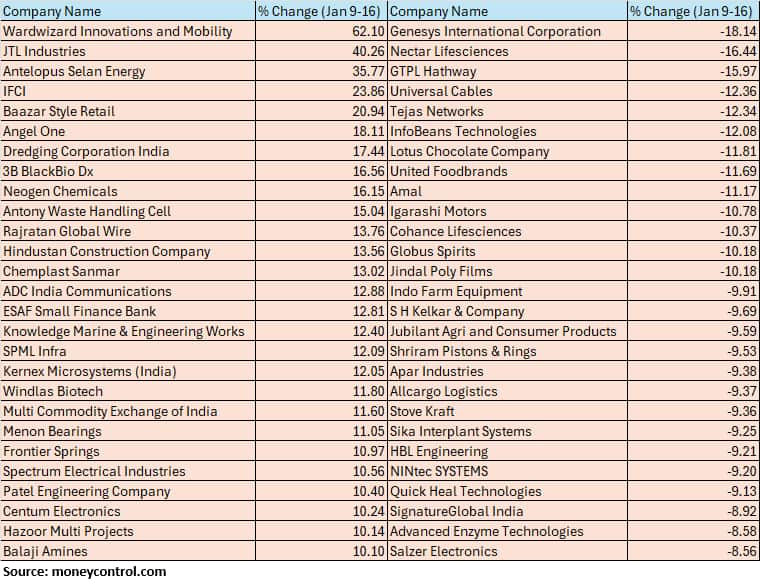
BSE’s smallcap index fell 0.5 percent last week. Genesys International Corporation, Nectar Lifesciences, GTPL Hathway, Universal Cables, Tejas Networks, InfoBeans Technologies, Lotus Chocolate Company, United Foodbrands, Amal, Igarashi Motors, Cohance Lifesciences, Globus Spirits and Jindal Poly Films saw a decline of 10-18 percent.

On the other hand, Wardwizard Innovations and Mobility, JTL Industries, Antelopus Selan Energy, IFCI, Baazar Style Retail, Angel One, Dredging Corporation India, 3B BlackBio Dx, Neogen Chemicals and Antony Waste Handling Cell saw a rise of 15-62 percent.

14332

How could the market move next week?

Nagaraj Shetty, Senior Technical Research Analyst at HDFC Securities Said that on the weekly chart Nifty formed a small bull candle with upper and lower shadow. Technically, this market action is a signal for the formation of a high wave type candle pattern after last week’s sharp weakness. Which shows the ongoing fluctuations in the market.

The internal trend of Nifty still remains fluctuating. A sustainable move above 25900 could provide further bullish momentum for the next week. However, if the market goes below the support of 25500, there may be further decline in the market.

Amol Athawale, VP Technical Research, Kotak Securities Said that the current market formation is volatile and non-directional, and short-term activity showing non-directional trends is likely to continue in the near future. On the downside, 25,500/83000 and 25,400/82700 will act as key support zones, while daily SMA (Simple Moving Average) at 25,950/84600 and 20-day SMA at 26,000/84800 will act as key resistance levels for the bulls.

For Bank Nifty, the uptrend is likely to continue as long as it is trading above the 20-day SMA at 59,500. On the upside, it can go up to 60,500. Further upside potential could take the index to 60,800. Conversely, if it falls below the 20-day SMA at 59,500, the uptrend will weaken.

Market This week: Market movement remained flat on weekly basis amid volatility, rupee continued to fall.

(Disclaimer: The views expressed on Moneycontrol.com are the personal views of the experts. The website or its management is not responsible for the same. Money Control advises users to seek the advice of certified experts before taking any investment decision.

Source link